
Criminal Court Records in Lawrence County
A criminal court record is the official file a court opens when the State of Mississippi brings a charge against a person. In Lawrence County, the Circuit Clerk keeps the felony case files, while the lower courts hold their own misdemeanor and traffic dockets. The file grows as the case moves forward. It can hold the charging document, bond papers, every motion, hearing notices, the plea or verdict, and the final sentencing order. Arrest reports and jail booking sheets are sheriff records, so they sit apart from the court case file even though they describe the same event. The pathway from an arrest to the filed charges is covered in the Lawrence County arrest records and court charges.
Several courts handle criminal matters in the county. The Lawrence County Circuit Court, part of the 15th Circuit Court District, is the felony trial court and hears the most serious cases. Justice Court takes county misdemeanors, traffic offenses written outside city limits, and the first appearances that can start a felony case. Municipal courts in Monticello, New Hebron, and Silver Creek handle city ordinance and misdemeanor charges. A felony often begins with a lower-court initial appearance, then moves to Circuit Court after a grand jury returns an indictment.
How to Search Lawrence County Criminal Court Records
Felony case records from Circuit Court are reached through Mississippi Electronic Courts, the statewide system known as MEC. Public users register through Public Access Mississippi Electronic Courts, often called PAMEC, before the full case search opens. Lawrence County Circuit Court went live on the system in 2016, so modern felony filings and dockets are indexed there. The Mississippi Judiciary explains that one login lets the public reach docket information and case documents in courts that use the system, which works like a CM/ECF filing platform rather than a simple name-only county page.
- Open the PAMEC registration page and create a public access login before searching.
- Select the 15th Circuit Court District so the search points at Lawrence County felony cases.
- Search by the defendant name, or enter the case number if you already have it.
- Open the case to read the docket entries, the charges, and the disposition.
- Request a certified copy from the Circuit Clerk when you need a court-accepted document.
Some criminal information lives outside the court file. The Mississippi Department of Corrections runs an inmate and parolee search for people sentenced to state custody. When a portal does not show a record, the courthouse public terminals at 517 East Broad Street in Monticello remain the free fallback, and the Circuit Clerk can be reached at 601-587-4791. The broader set of Lawrence County court records covers civil, chancery, and lower-court files alongside criminal cases.
Stages of a Lawrence County Criminal Case
A Lawrence County felony case follows a path that the record tracks step by step. Law enforcement makes an arrest, and the District Attorney decides whether to pursue charges. Hal Kittrell leads the 15th Circuit Court District Attorney's Office, which prosecutes felonies for Lawrence and four neighboring counties. For a felony, a grand jury reviews the evidence and may return an indictment, the formal charging document that moves the case into Circuit Court. Each event below leaves a dated entry in the docket.
Case flow: Charges Filed › Grand Jury / Indictment › Arraignment › Pretrial / Motions › Plea or Trial › Disposition › Sentencing
| Stage | What Happens |
|---|---|
| Grand Jury / Indictment | A grand jury weighs felony evidence and may return an indictment that states the formal charge. |
| Arraignment | The defendant hears the charges read in court and enters a plea such as guilty or not guilty. |
| Pretrial / Motions | Lawyers file motions, exchange discovery, argue bond, and set hearing dates before any trial. |
| Plea or Trial | The case ends in a plea agreement or moves to a jury or bench trial for a verdict. |
| Sentencing | After a guilty plea or verdict, the judge sets the penalty, from prison or probation to fines and restitution. |
What a Lawrence County Criminal Court Record Shows
A felony case file holds the full story of one prosecution. Each filing adds a dated line, so the record reads like a timeline from the first court date to the last. The State of Mississippi is the named party on one side, and the defendant on the other. Between those two names sit the charging instrument, the bond papers, the lawyer appearances, and every order the judge signs. The file also tracks money tied to the case, such as fines, court costs, restitution, and bond. Hearing entries show the date, the courtroom, and the type of hearing. Some details stay out of public view. Social Security numbers, full birth dates, account numbers, minor names, and sealed material are redacted or withheld under court rules.
The fields below appear across most Lawrence County felony files. Exact labels can shift by court and by year, so read each docket on its own terms.
| Field | What It Shows |
|---|---|
| Case Number | The court's unique ID for the case, used to pull the docket and any filed documents. |
| Defendant | The person charged, listed opposite the State of Mississippi as the prosecuting party. |
| Charges | The offense or offenses named in the indictment or information, with the statute cited. |
| Plea | The defendant's formal answer, such as guilty, not guilty, or no contest, entered at arraignment. |
| Disposition | The current or final outcome of each charge, from dismissal to conviction. |
| Sentence | The penalty after a guilty plea or verdict, including prison, probation, fines, or restitution. |
Charges vs. Convictions
Being charged is not the same as being convicted. A charge is an accusation. A conviction is a final ruling that the person committed the crime. A Lawrence County criminal court record can show charges that were later dropped, dismissed, or that ended in acquittal at trial. It can also show charges that were amended down to a lesser offense. The District Attorney needs only probable cause to bring a felony charge. A conviction needs proof beyond a reasonable doubt, the highest standard in law. Both stages live in the public case file, so a reader must check the disposition before drawing any conclusion. A name that appears on a charge years ago may carry no conviction at all.
| Charge | Conviction | |
|---|---|---|
| Stage | Accusation | Verdict or plea |
| Burden of Proof | Probable cause | Beyond reasonable doubt |
| Public Record | Yes | Yes |
Reading Dispositions and Sentences
The disposition is the heart of a criminal court record. It tells the reader how each charge ended. A guilty finding comes from a plea or a verdict. A not guilty finding is an acquittal. A dismissal means the charge was dropped before any verdict. Some defendants enter a nolo contendere, or no contest, plea, which accepts the penalty without admitting guilt. Others receive a deferred or nonadjudicated outcome, where the charge can clear after the person meets set conditions. Each charge in a multi-count case can end its own way.
The sentence sits next to the disposition once a conviction lands. In Lawrence County felony cases, a sentence can mean prison time with the Mississippi Department of Corrections, supervised probation, fines, court costs, and restitution to victims. The order spells out the term in years, any suspended portion, and the probation conditions. People sentenced to state custody then appear in a separate channel.
The Mississippi Department of Public Safety runs the state's sex offender registry for certain post-conviction cases.
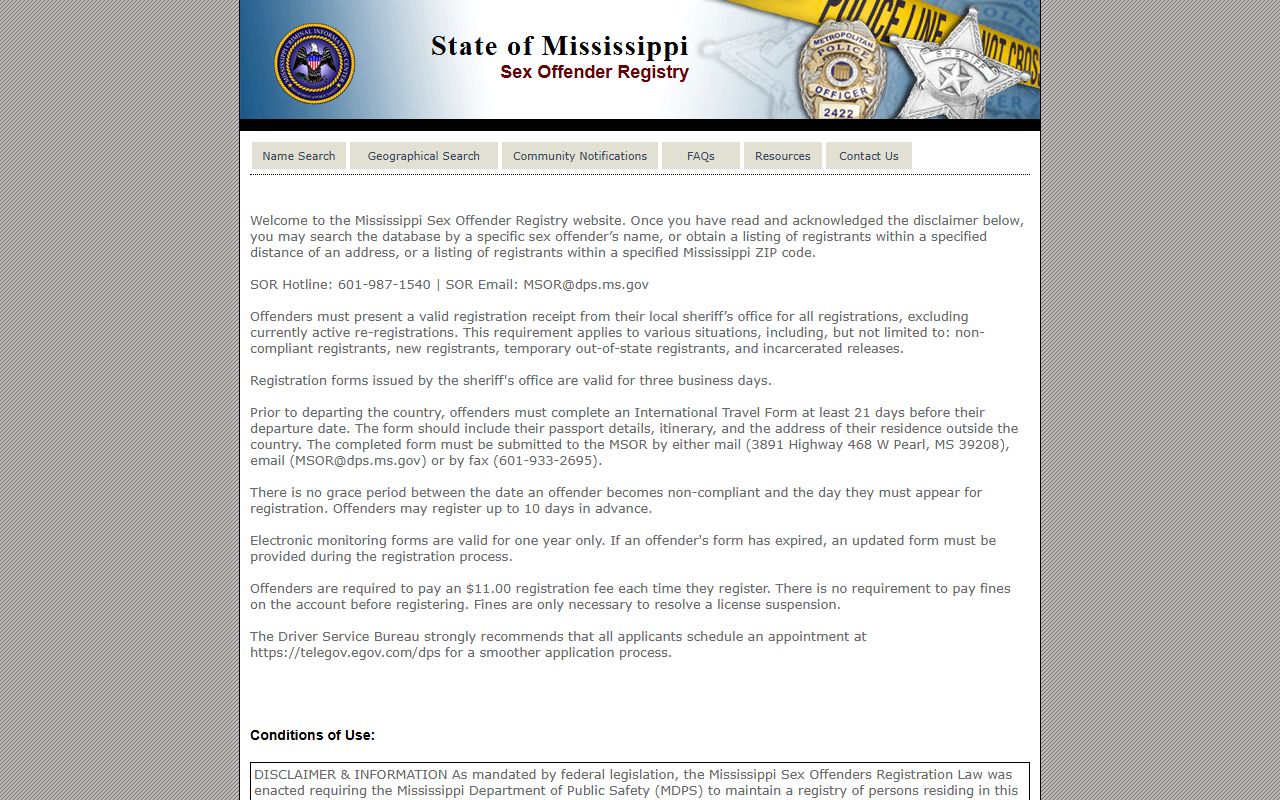
That registry is its own public record, separate from the court file, and it covers only convicted registrants rather than every criminal case. For a sentenced state prisoner, the Department of Corrections inmate search confirms custody and parole status long after the court file goes quiet.
Sealed vs. Expunged Records
Some criminal records leave public view by court order. Sealing hides a record from ordinary searches while the file still exists. Expunction goes further and removes the eligible record so it is treated as though it never happened. In Mississippi, expunction follows Miss. Code Ann. section 99-19-71. That statute can reach dismissed, acquitted, or no-disposition arrests, first-offense misdemeanors other than traffic, and certain felony convictions after the person meets the conditions. A Lawrence County expunction starts in the court that handled the arrest, charge, or conviction. The petition names the agency, the case number, the charge, and the disposition. If granted, the clerk and law enforcement clear or limit public access. Some government access can still remain.
| Sealed | Expunged | |
|---|---|---|
| Visibility | Hidden from public | Destroyed / treated as never existed |
| Law Enforcement | Limited access | Very limited |
| Eligibility | By court order in qualifying matters | Per Miss. Code section 99-19-71 conditions |
Public Access to Criminal Court Records
Most criminal case files are open to the public in Mississippi. The Public Records Act sets the baseline that public records stay open for inspection unless a law says otherwise. Felony case files in Lawrence County reach the public two ways. The first is online through MEC after a person registers. The second is in person at the Circuit Clerk counter at 517 East Broad Street in Monticello, where public terminals are free to use. The District Attorney, Hal Kittrell, prosecutes these cases for the 15th Circuit District, but the clerk holds the file. Open access has limits. Sealed orders, youth-court confidentiality, adoption rules, and expunctions all override the general right to inspect. When a portal hides a record, the clerk counter is the next stop.
Key Statutes:
Mississippi Code § 25-61-1 - Sets the state policy that public records stay open for inspection unless a law provides otherwise.
Mississippi Code § 99-19-71 - Sets who may expunge eligible arrests, dismissals, acquittals, and certain convictions from public view.
Background Check Considerations
A casual record lookup and a formal background check are not the same thing. Reading a Lawrence County case file for personal knowledge is open to anyone. Using a criminal record to decide on a job, a lease, credit, or insurance is different. Those uses fall under the federal Fair Credit Reporting Act, which sets strict rules on accuracy, notice, and dispute rights. A court file may show a charge without its final disposition, so a quick search can mislead. Anyone making an FCRA-regulated decision should work through a licensed screening firm that follows the law.
Important: This website is not a consumer reporting agency under the Fair Credit Reporting Act, and its records may not be used for employment, tenant, credit, or insurance screening.
Restricted Criminal Court Records in Lawrence County
Not every criminal matter is open. Youth court cases involving children are confidential by law. The Mississippi Bar explains the rights of juveniles who are arrested and how those records stay private.
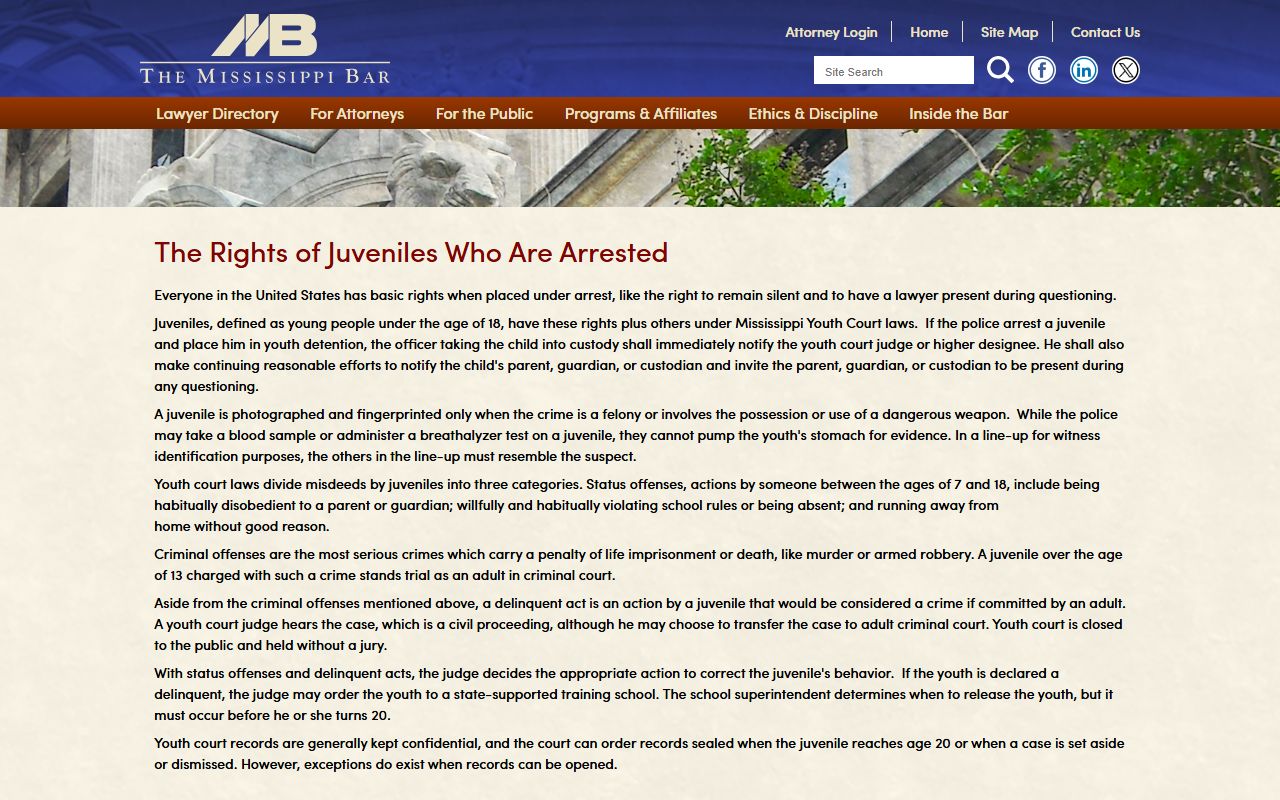
Youth records can be sealed once the person reaches a set age or the case is dismissed, subject to exceptions. Two statutes guard this area. Miss. Code Ann. section 43-21-255 limits the release of youth-court law-enforcement records, and section 43-21-261 keeps youth court records confidential except for authorized parties. Other files stay restricted too. Sealed cases, expunged matters, and adoption records do not appear in ordinary searches. Some details inside an open case are also withheld, such as victim addresses, minor names, and personal identifiers. Active investigations and sealed indictments may not surface until the court allows it. When a record will not load, the safest step is to call the Circuit Clerk at 601-587-4791 before assuming it is missing.